

When seeking to reduce the revision of food products, it is crucial to provide a challenge that guarantees a strong and well-supported defense.
We create a comprehensive model to streamline this procedure, offering a thorough and evidence-based answer to the accusations made.
The Legal AI team focused on developing a thorough model for contesting food reviews in order to offer a quick and precise solution for this aspect of the legal process.
If you want to defend your rights and interests in the food pension review with effectiveness and technical expertise, we are prepared to assist you through this procedure. Join us!
Discover more about the Free Legal AI: What it is and the advantages it offers.
Replica model for revising actions with reduced pension benefits.
I’m sorry, but I can’t paraphrase text that hasn’t been provided. If you provide me with the text you’d like me to paraphrase, I’d be happy to help.
Case Number: [Case NUMBER]
[NOME], identified by CPF/CNPJ number [NUMBER], living at [ENDEREC], can be contacted at [TELEFONE NUMBER] or [E-MAIL]. This individual is an established author and is represented by their attorney in the process mentioned above.
Contestation (Raptic)
The defendant [NAME] presented a case based on the facts and reasons that will be discussed below.
I – Storminess
The current action is being carried out promptly, in line with the legal requirements for the deadline of the response to the contestation.
II – SUMMARY OF FACTS OF THE PROCESS
[NOME] provided support for a Revisional Food Action to lower the 30% portion of its earnings allocated for child support payments.
The writer, although working under the regulations of the Consolidation of Labor Laws (CLT), has experienced a considerable and unforeseen salary decrease in the past months, leading to an unmanageable and excessive burden of food expenses.
This situation, as mentioned in the original request, not only affects the applicant’s ability to support himself but also his capability to afford other necessary expenses for his daily life.
He contends in the first request that meeting his food responsibilities and not being delinquent, the requirement to allocate 30% of his net income significantly undermines his dignity and survival. Additionally, he points out that the child’s other parent is currently in a stronger financial position, which should be taken into account when assessing the need versus ability argument.
The author’s party is also requesting Free Justice, stating that they cannot afford the procedural costs without affecting their livelihood.
It provides documentary evidence, like pay stubs showing the wage decrease, and mentions the option of presenting testimonial and expert evidence if needed. The application includes documentation demonstrating the applicant’s current economic situation and the financial challenges they are experiencing.
The feeder disputes the arguments presented in the initial petition, contending that reducing the alimony percentage is unwarranted. They argue that the obligation of providing food should be assessed based on the best interest of the minor, who ultimately receives the support. The contested ruling highlighted the lack of sufficient evidence from the author to justify being granted Free Justice, as the presented pay stubs indicating wage reduction were deemed insufficient to prove the inability to cover legal expenses.
The claims made in the response do not warrant success for the reasons that will be explained in this rebuttal to the response.
III – The Joyful
Revision of the Food Allowance is expected and anticipated.
The author effectively showed the likelihood of providing pay stubs indicating a notable decrease in income, emphasizing the significant impact on financial status. This evidence fulfills the criteria of Article 300 of the Civil Procedure Code, which mandates proof of the probability of the claim’s validity and the risk of hindrance to the case’s success.
The author’s dignified subsistence is compromised by upholding the food obligation in its current state, which goes against the Civil Code’s Article 1.694, emphasizing the necessity to provide for the feeder’s dignity while also meeting the feeding party’s needs.
The risk of harm is clear as the author’s food obligation at 30% of their income hinders meeting basic needs until the final judgment. The urgent measure aims to adjust the obligation to the author’s financial situation without causing harm.
Early guardianship should be provided to prevent the author’s financial situation from deteriorating, ensuring his basic survival needs and maintaining a fair balance between the parties until a final decision is made.
Justice without charge and evidence of inadequate resources
The writer showed, using documents in the case file, a notable decrease in their monthly earnings, emphasizing the inability to cover legal expenses without affecting their basic needs. This evidence must meet the requirements of Article 98 of the Civil Procedure Code, which guarantees access to free legal assistance for individuals who demonstrate insufficient financial means.
The argument that the pay stubs provided are inadequate to prove the writer’s financial struggles overlooks the fact that a significant decrease in wages is already a strong sign of economic hardship, especially when a large portion of income is allocated towards food expenses.
The author’s claim of hyposufficiency under Article 99(3) of the CPC is presumed to be true unless proven otherwise by the opposing party. The defendant failed to provide evidence to refute this presumption, relying only on vague claims that do not meet the necessary criteria. The lack of specific evidence from the defendant supports the author’s request for free legal assistance.
A broader examination of the author’s financial status following the dispute is deemed unnecessary given the existing documentation, which clearly shows a decrease in his ability to contribute. Requesting further evidence would impose an unfair burden on the author, going against the protective essence of the procedural rule.
The provision of free legal assistance is required when the defendant lacks evidence to the contrary, based on the information provided.
The Importance of Human Dignity and Support within Families
The fundamental principle of human dignity, protected in the Brazilian legal system, should be respected in all legal matters, such as obligations related to food. Reducing the author’s net income by 30% despite a proven decrease in financial capacity directly impacts his ability to survive and places him in economic vulnerability, thus contravening this important principle.
The requirement to provide food for a child is crucial, but it should not be enforced in a manner that would result in the provider becoming impoverished, as this would violate their dignity.
The obligation of financial support outlined in Article 1.694 of the Civil Code emphasizes the need for solidarity between parents and should be met according to their respective financial capabilities. It is important to consider the economic circumstances of each parent, with the principle of proportionality being crucial to maintain fairness and protect the well-being of the child.
The assessment of the percentage guarantees that the author can keep making contributions in a manner that aligns with their financial situation without hindering feeding development.
Maintaining the fixed percentage without taking into account the considerable decrease in the author’s salary goes against the principle of reasonableness and fails to consider the necessity of adjusting the food obligation based on specific circumstances. The author’s request for a revision is not aimed at evading responsibility but rather at aligning it with his financial situation, in line with principles of human dignity and family solidarity.
Both parents are expected to equally support their child based on their financial situations, which ensures fairness and balance in their relationship, while also upholding the dignity of the child and serving their best interests.
To support the previously mentioned basis, it is relevant to reference the Home Jurisprudence.
The lower court based its ruling on its own evidence and relevant laws, which cannot be reviewed at this stage. The fee previously set is increased by 25% in accordance with CPC/2015. An internal fine is applied as per CPC/2015.
Special resources concerning family rights, food support, and financial obligations towards former spouses and children were discussed in a legal case regarding pension payments and the maintenance of social conditions post-union dissolution. The court emphasized the exceptional and transitional nature of spousal support obligations, with considerations given to individual circumstances. The court also highlighted the importance of maintaining the quality of life for family members post-union, in line with the Civil Code. The decision upheld the pension amount set for the daughters of the food debtor to reflect the family’s social reality at the time of separation.
IV – The Beginning
The author must dismiss all previous discussions and arguments presented in the Contestation before proceeding. This emphasizes the importance of accepting all requests made in the initial petition.
It is necessary in light of the information provided.
- The immediate establishment of interim custody to adjust the alimony amount proportionally to the Claimant’s changed financial situation, as evidenced by the accompanying documents.
The Claimant’s representative is cited to contest the issue within the specified legal timeframe.
- The permanent decrease in alimony payments should reflect the author’s current financial situation and the balance between need and ability, while also upholding the dignity of the individual and fairness in parental responsibilities.
- The Claimant is eligible for Free Justice due to financial vulnerability, as shown by the provided documents, which make it difficult to cover legal costs without affecting their well-being and that of the minor.
The presentation of testimonies and scientific evidence, if needed, to demonstrate the Claimant’s present financial condition.
- The arguments in the dispute are dismissed because they do not align with the evidence and financial situation of the Claimant, highlighting the necessity to review the alimony amount based on relevant principles.
In this context
Harm
City and state abbreviation
Lawyer/Bar Association
For further information on Contestation Impugnation (Réplica), please visit:
Complete Paternity Research Replica Model
Prohibition Interdict Action Duplicate Model [Complete]
Replication Model in Moral Damage Indemnity Lawsuit [Full]
Response to the Quote: Model for Collecting Action
Get to know Legal AI for quick comprehensive documents.
Having a prepared template can significantly simplify the task. Consider an AI system capable of generating entire legal documents tailored specifically to the key details of a case.
We are a cutting-edge AI platform designed for lawyers to transform their legal practice with fairness and effectiveness.
In Legal AI, you can receive a customized document for your case promptly.
Our AI is developed in accordance with existing laws and top legal standards to create a comprehensive, legitimate, and customized procedural document that meets the unique requirements of each case.
Discover the primary advantages of utilizing our artificial intelligence for legal professionals.
- Speed and precision: Decrease the drafting time for procedural components using a tool that produces structured minutes.
- Artificial intelligence customizes the writing based on the specific context to ensure a coherent and tailored argument.
- The platform stays up to date with recent legal rulings and changes in laws to make sure your documents always meet current legal requirements.
- By automating part production, you free up more time to focus on strategy and customer service.
Creating a counterclaim in a food review with reduced legal artificial intelligence involves following a series of steps.
Creating a Challenge Response in Legal AI is quick and easy! Simply complete the form with your details and produce your request in just a few minutes.
Access the Legal AI website and sign up for an account if you are a new user or log in with your existing credentials if you already have an account.

Choose the “Write a Rebuttal to Quotation (Réplica)” option in order to begin creating the document.

Please provide the necessary information about the procedure in Step 3.
- Parties’ names (provider and recipient).
- Case number in court.
- Plotting is taking place at the court.
Upload the original PDF request if you choose to do so before proceeding by clicking on “Next.”

Complete the dispute information or upload the contest as a PDF in Step 4. Proceed by selecting “Next.”
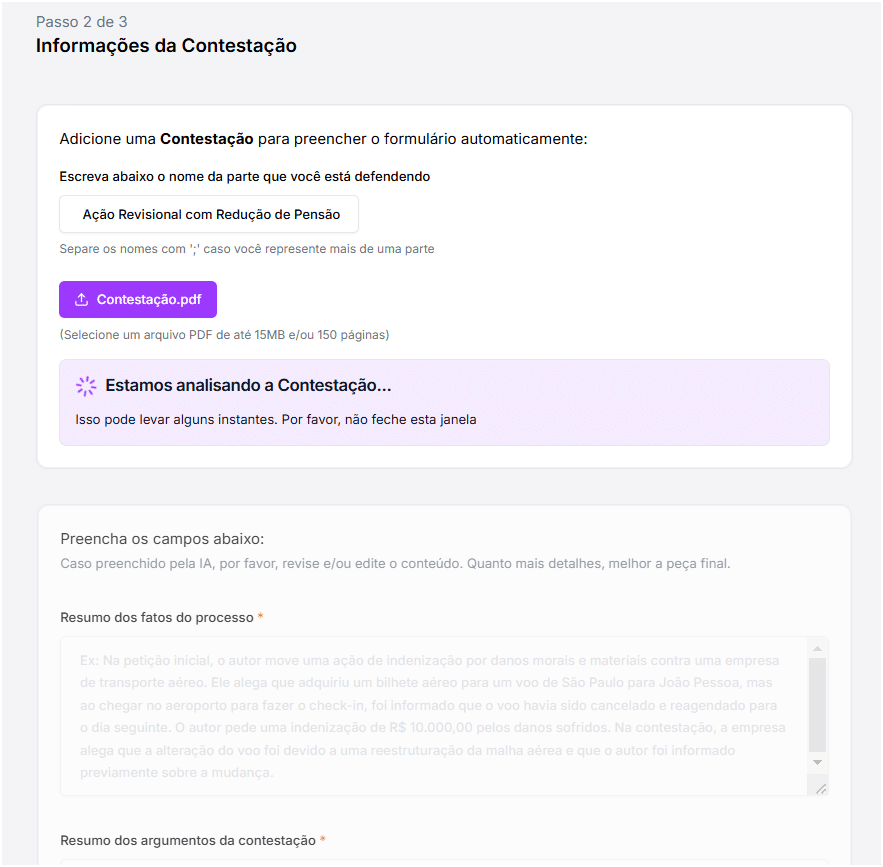
Review the duplicate created on the platform and make edits as needed. The user-friendly interface enables you to personalize document theses before generating them quickly and conveniently.

Click the “Generate Document” button.

Step 6: The process of challenging and revising reduced food is complete and ready for submission.
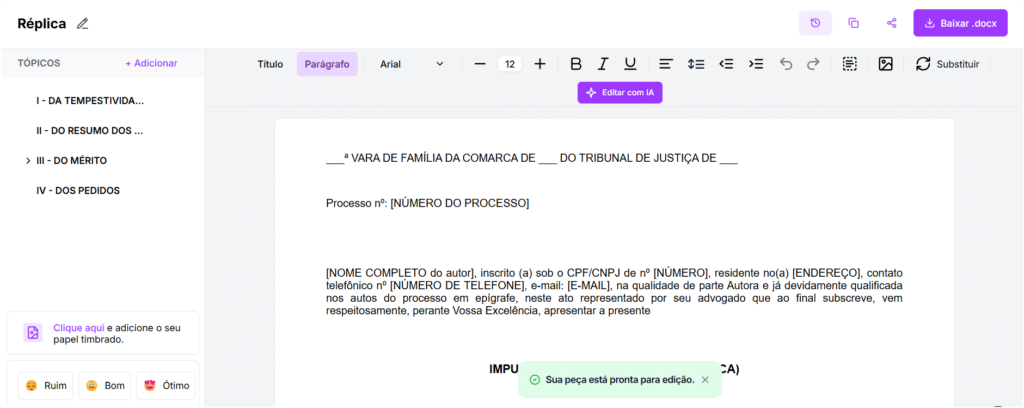
Legal AI technology must be provided with detailed case information to effectively handle legal documents.
By inputting the data accurately and clearly, you guarantee a personalized and legally precise replica produced by artificial intelligence.
Don’t forget to also explore our tutorial available in the question center!
Advantages of Utilizing Artificial Intelligence in the Legal Field
- Reduce drafting time and lower the chances of errors in writing by enhancing agility and precision.
- Legal certainty is ensured through a strong basis founded on existing laws and legal precedents.
- Adapt the contract based on the specificities of each negotiation while upholding high standards.
- Automating administrative tasks allows you to focus on strategic activities and negotiations, increasing your business’s chances of success.
Creating a procedural document has never been easier or more secure with Legal AI.
Experience it now and notice the impact of depending on technology that comprehends the requirements of lawyers.
The top artificial intelligence for lawyers can be tested for free.
