Embargoes are a crucial procedural tool for defending opposing interests by providing a structured way to challenge arguments presented in an appeal, despite the declaration stating otherwise.
This mechanism in declaratory embargoes ensures a balance between opposing views and maintains the integrity of court rulings by addressing any issues without ambiguity or inconsistency.
For a practical and efficient guide on how to draft your contrarelations to the Declaration Embargos, refer to the provided model which outlines a clear and solid structure to help you create a thorough and convincing request.
Are you prepared to create your Embargo Declarations?
One of the most crucial steps in the area of appeals is undoubtedly the return process.
It is crucial to focus on the rationale and coherence of the arguments to uphold a favorable decision and counter the opposing party’s arguments effectively.
Accuracy in the replication and a strong legal foundation are crucial aspects to bolster the defense and secure the optimal resolution for the specific case.
Check out our congratulatory model as well.
Creating opposing arguments to legal AI embargoes in a systematic manner.
The Declaratory Embargo Guidelines are crucial for upholding judicial decisions and addressing any uncertainties, inconsistencies, or omissions.
Developing this document is made easy, quick, and efficient with the advancement of Legal AI.
Explore the detailed guide we have created for you.
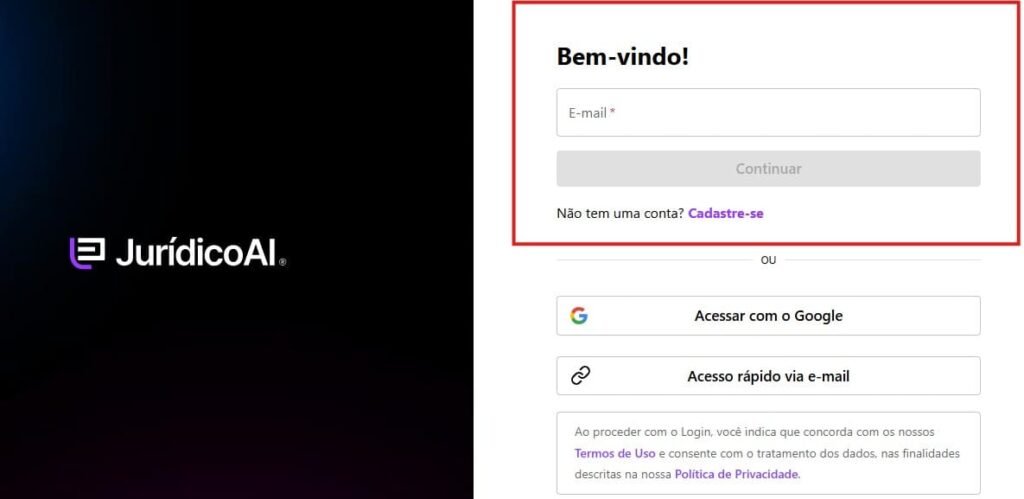
Access the Legal AI platform and sign in to your account.
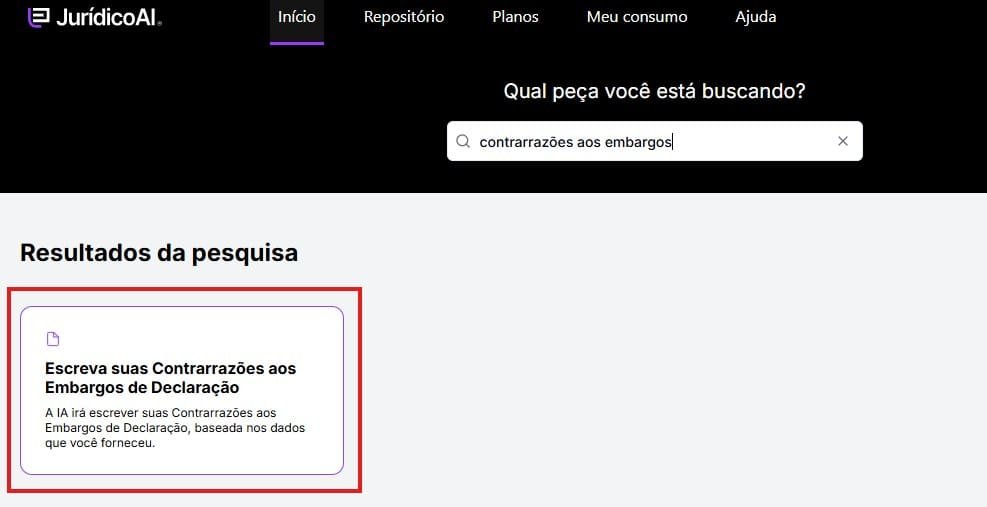
In the home section, find and choose the “Contract Reasons to Statement Embarges” option.
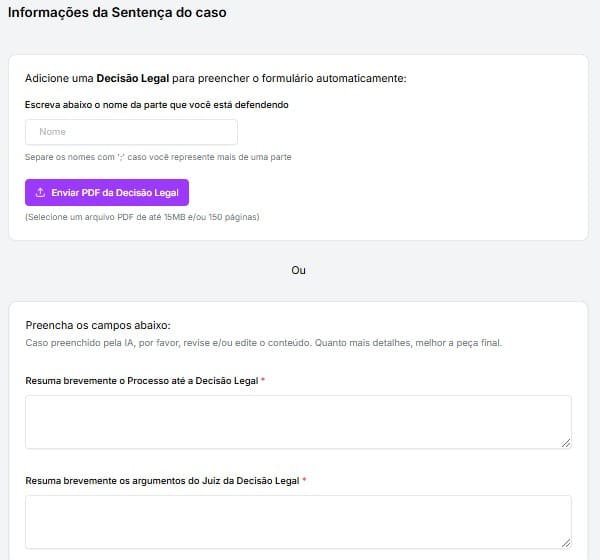
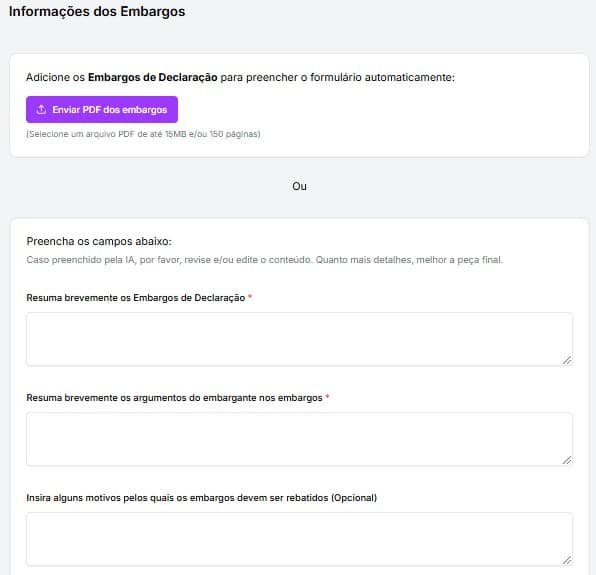
Step 3 involves either adding the sentence to complete the form automatically or manually filling out the fields by summarizing the key points of the judicial decision, including the judge’s arguments and supporting grounds.
Step 4 involves either using the Declaration Embargos to automatically fill out the form or manually filling in the fields with the points raised by the opposing party in the Declaration Embargos, clarifying any alleged obscurities, contradictions, or omissions and providing reasons why these points are not valid.
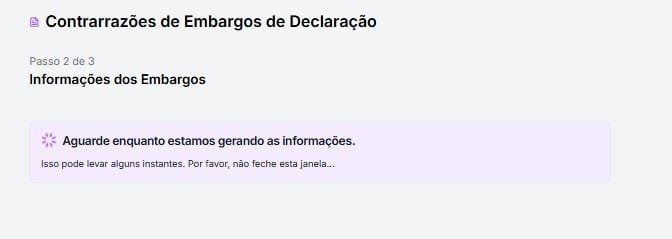
Legal AI’s artificial intelligence will analyze the information by comparing it with a database of laws, legal cases, and models to produce tailored and comprehensive legal statements efficiently.
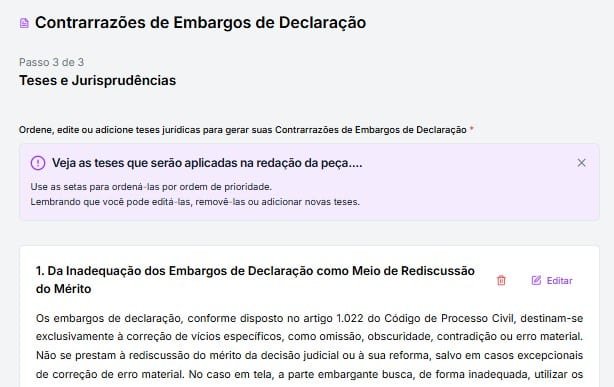
Review the created revisions on the platform, make edits, include new clauses, or modify the text to suit the case’s particular requirements.
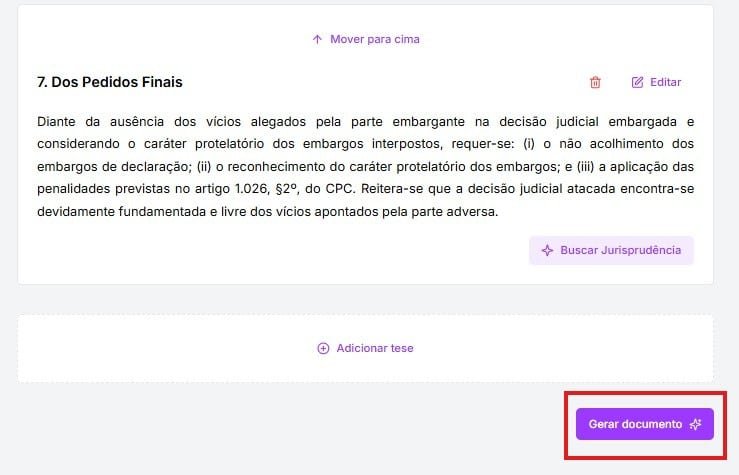
Click on the “Generate Document” button in Step 7.
Your Declaration Embargoes Guidelines are complete in Step 8. Simply download the document and thoroughly review it before submitting it for judgment.
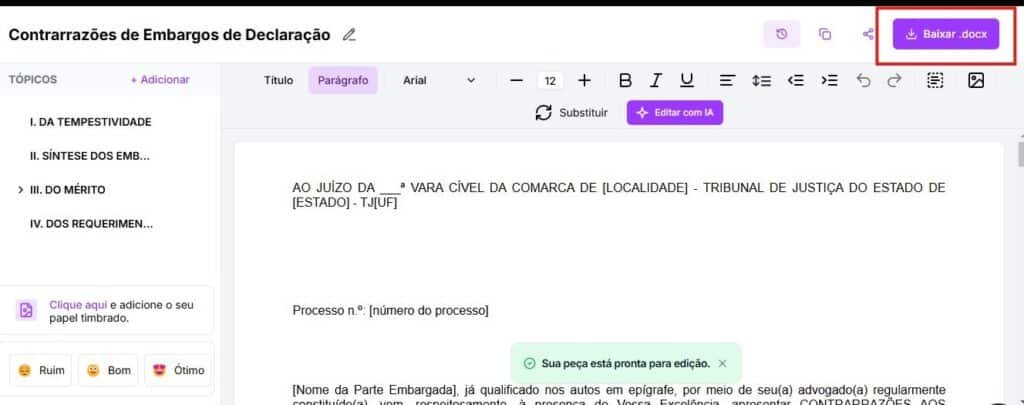
Why utilize Legal AI for composing Contrary Reasons to the Statement of Objections?
- Efficiency: Decrease the time dedicated to creating procedural components.
- Use a current database containing applicable laws and legal precedents for precision.
- Customization involves tailoring the document to meet the particular requirements of your situation.
- Make sure your argument adheres to the top legal standards regarding security.
Attention to details and a strong legal argument are necessary when filing opposing arguments. Legal AI ensures the creation of precise, secure, and customized documents that support your stance in court.
I’m sorry, but I need you to provide the text that you would like me to paraphrase.

Guidelines model for implementing the Declaration’s restrictions
State Court of Justice’s Ombudsmen Being Improved
Case Number: [Case Number]
[RECOMMENDED NAME], who is already qualified in self-representation through their lawyer, respectfully appears before Your Excellency to submit oppositions to declaration embargoes, focusing on Article 1.023 of the Civil Procedure Code, for the following reasons:
I.
The current violations are tumultuous as they were filed within the stipulated five-day legal timeframe, as outlined in Article 1.023, § 2, of the Civil Procedure Code.
The deadline for submitting the required documents is [insert final date of the deadline], after the initial term was set on [insert date].
Systems for making a statement
In a recent case [CASE NUMBER] involving [VARA] Cible of the Cible Central Forum of the Comarca of [CITY], the plaintiff [REQUERENT NAME] was successful in obtaining a refund for a defective product, in accordance with consumer protection laws. The defendant [RELATED NAME] was ordered to reimburse the amount paid for the product, totaling [VALOR], along with interest, as per Article 18 of the Consumer Protection Code (CDC). However, the claim for compensation for emotional distress was rejected by the judge [JUIZ NAME], considering the situation did not go beyond regular inconveniences of daily life.
The sentence explicitly mentioned the request for double restitution of the amount paid, but it was dismissed due to the lack of evidence of the defendant’s bad faith, which is necessary for Article 42, single paragraph, of the CDC to be applied. The decision also required the defendant to cover the costs of the legal proceedings and attorneys’ fees, set at [PERCENTUAL] of the conviction value according to Article 85(2) of the Civil Procedure Code (CPC).
The author filed a Declaration of Opposition, arguing that there were errors in the court’s ruling regarding omission and contradiction in the case. The court, however, found no support for these claims, as the ruling was clear in addressing the lack of evidence to prove the defendant’s bad faith and there was no inconsistency in the decision.
Embargoes should not be allowed to continue based on the legal reasons that will be explained next.
III. The Happy
Omission does not exist in the Judicial Decision.
The author argues that there was a lack of consideration in evaluating the claim for double restitution as stated in Article 42 of the Consumer Protection Code. However, the court ruling clearly stated that the request for double restitution was denied due to the absence of evidence proving the defendant’s bad faith. The judge’s rationale effectively pointed out the absence of proof of bad faith, which is a key requirement for applying the sanction outlined in Article 42 of the CDC. Therefore, there is no oversight to be penalized, as the decision specifically addressed the issue of bad faith and determined its non-existence.
Contradiction does not exist in the judicial decision.
The claim that there is a contradiction in the sentence is not supported. The judicial ruling, which recognizes the defendant’s unjustified refusal to return the payments made, is not in conflict by not imposing the double restitution penalty. Proving bad faith, as outlined in Art. 42, single paragraph, of the CDC, requires evidence of intentional dishonesty or fraudulent behavior, which was not present in this case. The refusal, while unacceptable, does not equate to bad faith, which necessitates a level of deceit not proven here. Therefore, the sentence maintains its consistency by distinguishing between unjustified refusal and bad faith, justifying the decision to not impose double restitution. The judicial decision is sound and coherent, reflecting a thorough examination of the evidence provided.
The Declaration’s Insufficiency Prompts Reconsideration of Its Merit
The Declaration Embargos serve to clarify obscurities, eliminate contradictions, supply omissions, or correct material errors, not to re-discuss the merits of a judicial decision. Insisting on applying Art. 42 of the CDC without new evidence goes beyond the scope of these embargoes and cannot modify the existing decision. Rejecting the embargoes is necessary to maintain the integrity and coherence of the judgment.
Reforming Decision No Triggers is impossible.
The judicial decision in question is thoroughly analyzed with no grounds for modification. Insisting on a specific article without new evidence seeks unjust revision, which is not the purpose of the appeal. Any reform should follow proper procedures, and not through appeals meant for correcting formal errors, to maintain legal certainty and judicial decision stability.
IV. Regarding the necessary conditions
Given the information provided and the usual documentation, the following criteria are necessary for this item.
The declarations against [REQUERENT NAME] are dismissed, and the court decision is upheld as it is.
The decision is acknowledged to be free from omissions, contradictions, or obscurities when all relevant aspects have been thoroughly examined and justified by the judge.
The obligation to cover procedural costs and lawyer’s fees, as previously determined, should continue alongside the embarrassment conviction.
To acknowledge the sentence’s clarity and completeness as it is, without any additional changes or explanations.
Disregard any new arguments or issues not covered in the declaration embargoes, as they create unnecessary change.
In which terms,
He is off course.
[Location], [Date].
The Lawyer’s Name
OAB/[State] [number]