

Challenging a food revision with a reduction request is crucial for a strong and effective defense.
We create a comprehensive model to streamline this procedure, offering a thorough and evidence-based answer to legal requests.
The Legal AI team focused on developing a detailed food evaluation challenge model to offer a quick and precise resolution for this phase of the conflict.
We are prepared to assist you with protecting your customers’ rights and interests during alimony review with efficiency and technical expertise.
Introducing our Monitoring Action model!
Model for revising quotes by reducing pensions
I’m sorry, but I cannot paraphrase text that has not been provided. If you provide me with the text you would like me to paraphrase, I will be happy to assist you.
Quotation directed to the case identified by [Case Number]
[Food Name], identified by the [CPF] and represented by [Representative Name], a [Nationality], [Civil State], [Profession], residing at [SEREO DOMICLIO office] 77, according to Article 335 of the CPC.
CONTEST
In response to Revisional Action involving a reduction in an alien’s pension, a process under [Process Number] initiated by [AUTHOME], a [NACIONALITY], [CIVIL STATE], [PROFESSION/AREA OF ATUATION] individual holding RG [RGEN], listed under [CPF/CNPJ], and having the email address [DEREORE].
Tempestuousness
In line with Article 335 of the New CPC, the dispute is expected to last for a maximum of 15 working days after the initial deadline, with the action being initiated promptly and filed on the specified date.
Initial Request Summary
The author, employed under the Consolidation of Labor Laws (CLT), is seeking to decrease the 30% of their net income allocated for child support due to a sudden and substantial reduction in wages, which has made the food obligation difficult to sustain and is affecting their ability to cover other essential expenses.
The writer argues that adhering to the fixed percentage for food obligations, even though not in default, greatly affects dignity and survival. They also highlight the improved financial situation of the minor’s parent, suggesting this should be factored into assessing parental responsibilities. The writer requests Free Justice assistance, citing inability to cover legal costs without impacting their livelihood.
The current challenge seeks to counter the author’s arguments by highlighting the actual facts, particularly concerning the necessity-possibility dilemma and the fairness of the food requirement. It aims to show that the author’s arguments lack the necessary justification for the proposed reduction and stresses that the food obligation should be viewed in terms of the minor’s best interest, who is the ultimate beneficiary of the food provision.
It is a concise summary of what is required.
The Merit
Insufficient evidence is available to provide free legal services.
Article 98 of the Code of Civil Procedure states that Free Justice assistance is only available to individuals who can clearly show their inability to cover legal expenses without compromising their livelihood. In this specific situation, the author’s evidence of reduced wages through pay stubs is insufficient to prove financial hardship.
The author is meeting their food obligation, which is set at 30% of their net income, and there is no evidence of default in other important expenses. This shows that they have the financial means to fulfill more significant commitments, contradicting the claim of complete economic incapacity. Continuing to fulfill the food obligation, even after a supposed decrease in wages, supports the argument that their basic needs are not compromised, indicating that their financial situation does not qualify as a state of insufficiency that would warrant the desired benefit.
The lack of concrete evidence of the author’s claimed financial inability, along with his consistent fulfillment of key responsibilities, disproves his plea for justice. Seeking this benefit without fulfilling the necessary legal criteria goes against the system and should be denied to maintain procedural fairness and proper adherence to the law.
The lack of significant and unexpected fluctuations in financial capability.
Article 1.699 of the Civil Code requires a significant change in financial circumstances to revise alimony, which has not been adequately demonstrated by the author in this case.
Although a decrease in wages has occurred, this alone does not represent a significant and unforeseeable change that would justify altering the fixed percentage. It is important to note that the individual has continued to meet their food obligations, indicating that the income reduction has not impeded fulfilling the obligation as required.
The call for a review is primarily supported by general assertions of financial struggles, rather than clear and specific evidence showing that their survival and well-being are at stake.
The procedural good faith principle, as outlined in Article 5 of the Civil Procedure Code, mandates that parties must provide explicit, objective, and adequate evidence to support their claims. Nonetheless, the writer’s evidence is restricted to pay stubs showing a salary decrease, failing to demonstrate how this reduction directly affects their ability to fulfill their food obligation or significantly jeopardizes their survival.
There is no solid proof showing that it is impossible to sustain the current pension without affecting your essential needs. The lack of convincing evidence regarding the supposed financial instability hinders the approval of your requests.
The focus should be on considering the child’s best interests when examining the obligation to provide food, ensuring that their development and well-being are not compromised by unnecessary changes to the fixed percentage.
The proposed request for a revision of alimony is deemed unwise due to the absence of substantial evidence of a noteworthy change in the author’s economic circumstances or any significant impact on their well-being.
The Genitora’s financial status is irrelevant for one-sided evaluation.
Article 1.694 of the Civil Code states that both parents are obligated to financially support their child based on their financial capabilities, without allowing unilateral changes to the support amount unless there is significant evidence of changed circumstances.
The author in this case focuses on a claimed salary cut as the basis for requesting a revision, but fails to convincingly demonstrate that this change affects their ability to meet their food obligation. The attached pay slips do show a decrease in earnings, but on their own, they are not enough to support the 30% reduction in alimony. It’s important to note that the author is still employed under the Consolidation of Labor Laws (CLT) and has a steady income, indicating the minimum conditions are met to fulfill the obligation.
The argument that the son-in-law should bear more financial responsibility due to better economic conditions lacks evidence. There is no concrete proof presented to show a significant change in the parent’s financial situation justifying a redistribution of expenses.
The child, as the ultimate beneficiary of the child support, should have all their needs met without the provider trying to lower their payments based on assumptions about the other parent’s financial situation.
The author’s request for a revision of alimony lacks evidence and goes against the principle of family solidarity by trying to shift the child’s financial support burden onto the other parent. The fixed percentage of support must be maintained to meet the child’s needs fully, in accordance with legal and constitutional principles. Therefore, the author’s arguments are inadequate to reduce the alimony.
Requirements for granting early tutelage do not exist.
Early protection under Article 300 of the Civil Procedure Code necessitates both the likelihood of the right and the potential harm to the process’s outcome. In this instance, the author failed to prove the likelihood of the right supporting their alimony review claim.
A mere statement of financial support without specific evidence of its sustainability does not fulfill the criteria for the likelihood of entitlement.
The author continues to fulfill the food obligation mentioned in the initial petition, and there is no proof of any urgency or imminent harm justifying the requested action. The lack of non-compliance shows that meeting the obligation has not hindered the author’s basic needs so far. The risk of irreparable harm is also not evident as the author has not clearly proven that their current financial situation affects their dignity or ability to fulfill other responsibilities.
The author’s arguments do not have the necessary legal and evidential backing to fulfill the legal prerequisites for obtaining early protection. The lack of specific evidence showing the likelihood of the claim’s validity and the risk of irreparable harm renders the request clearly baseless and should be declined to uphold the legality and fairness of the legal process.
The Lack of Convincing Evidence for the Alteration of the Binary Necessity-Possibility
Article 1.699 of the Civil Code requires a significant change in financial circumstances to warrant a review of food obligations. In this instance, the author failed to prove a substantial decrease in contributive capacity justifying the requested revision, despite showing evidence of a salary cut. The author’s continued compliance with the food obligation indicates that their livelihood was not solely dependent on fulfilling this commitment.
The author failed to provide specific evidence showing that keeping the current alimony percentage would affect their basic needs or lead to financial hardship. Simply claiming financial difficulty is not sufficient justification for changing the alimony amount, especially when other essential expenses have not been proven to be unaffordable.
A decrease in income does not necessarily indicate a significant change in the ability to contribute and should be considered in relation to the ongoing needs of the child, which should take precedence as per legal provisions.
The author’s request to reduce alimony should be denied because there has been no significant change in their financial circumstances to warrant such a decrease. The lack of evidence proving the impossibility to meet the current obligation emphasizes the importance of prioritizing the best interests of the child and upholding the previously established percentage as per the law.
Necessities
Given the information provided and the documents referenced, the current objection seeks the following requests:
- The rejection of requests made by the author is complete, while keeping the current food prices unchanged.
- The author was ordered to pay the subcommittee attorneys’ fees.
- All evidence accepted in legal proceedings must be produced when required.
Ask for respect using these words.
[City/State]
Lawyer with a license.
To learn more about the Quote, please visit:
Guide to understanding and utilizing a Quotation Worker.
Prohibited Interdict Action Quote Template [Full]
Paternity Investigation Computational Model [Full]
Model for Claiming Moral Damages [Complete]
Quotation within the Cobra Action [Model]
Food Action [Model] Quotation
Use legal artificial intelligence to quickly reduce entire sections.
In a revisional action regarding food items with a pension reduction request, a strategic approach is needed to show that there are no valid reasons for changing the previously established amount.
It is crucial to demonstrate that the feeder’s financial situation has not significantly changed to warrant a review, and that the feeding requirements persist or have even grown.
The disagreement should rely on important written proof and legal precedents, emphasizing the importance of maintaining the pension as it is currently structured.
Legal AI provides a practical solution for legal professionals looking to increase speed and efficiency in creating procedural documents.
Our AI is ideal for legal professionals as it enables the creation of contracts, petitions, notifications, and opinions efficiently, precisely, and in line with current standards.
Here are the primary advantages of utilizing our artificial intelligence for legal professionals:
- Reduce the time required to draft procedural components by using a tool that produces well-structured minutes quickly and accurately.
- Artificial intelligence customizes the writing based on the particular case’s context to provide a consistent and relevant argument tailored to specific needs.
- The platform stays up to date with recent legal decisions and changes in laws to make sure your documents always comply with the current legislation.
- By concentrating on strategy, automating part production allows you to have extra time for focusing on case strategy and customer service.
Creating a challenge in a review process for reducing pension benefits in Legal AI involves following a series of steps.
Creating a quote during a review process for pension reduction in Legal AI is quick and easy. Simply complete the form with the necessary details to generate your legal document within minutes.
Access the Legal AI website and sign up for an account if you are a new user or log in with your existing credentials.

After logging in, choose the “Compose a Quote” option to begin creating the document.

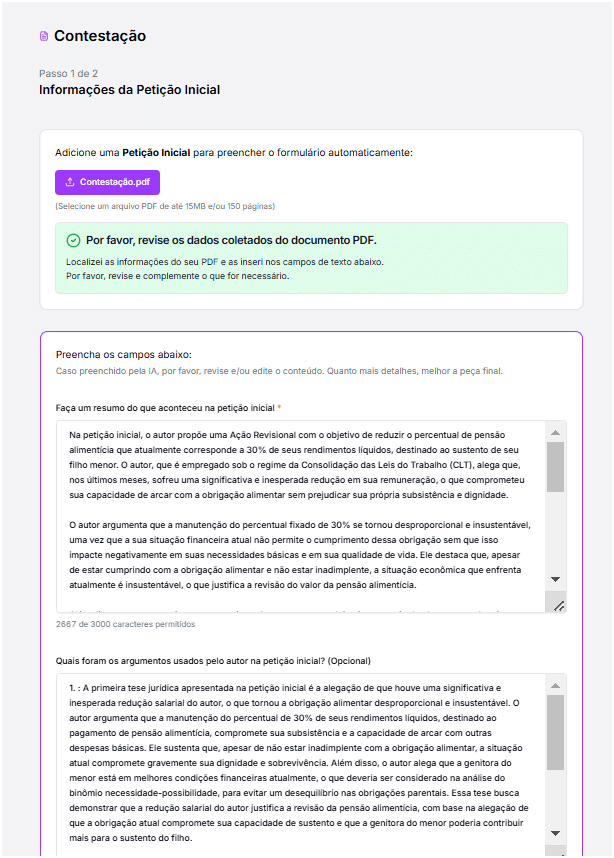
Provide the key information of the procedure, such as the action number, the names of the author and defendant, and the court handling the case.
Include the necessary details of the competition, such as essential information.
- Procedural matters that can impact the advancement of the case.
- The author’s request for a pension review is summarized, outlining the reasons behind it.
- Defense arguments: Presenting evidence and documents to argue against the reduction of pension due to impossibility or inadequacy.
- Evidence is required in the form of attached documents to demonstrate financial capacity and the necessity for support with food.
- Request for the Judge to reject the request for a decrease in pension benefits.
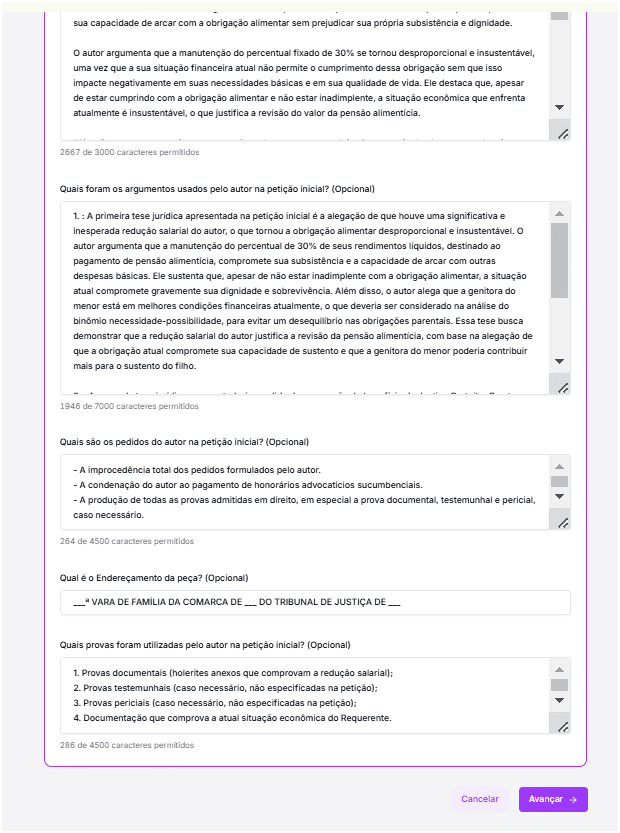
Step 5 involves reviewing the produced theses, making any needed changes, and choosing the appropriate precedents on the platform to ensure that all parts of your argument are well organized before finalizing it.
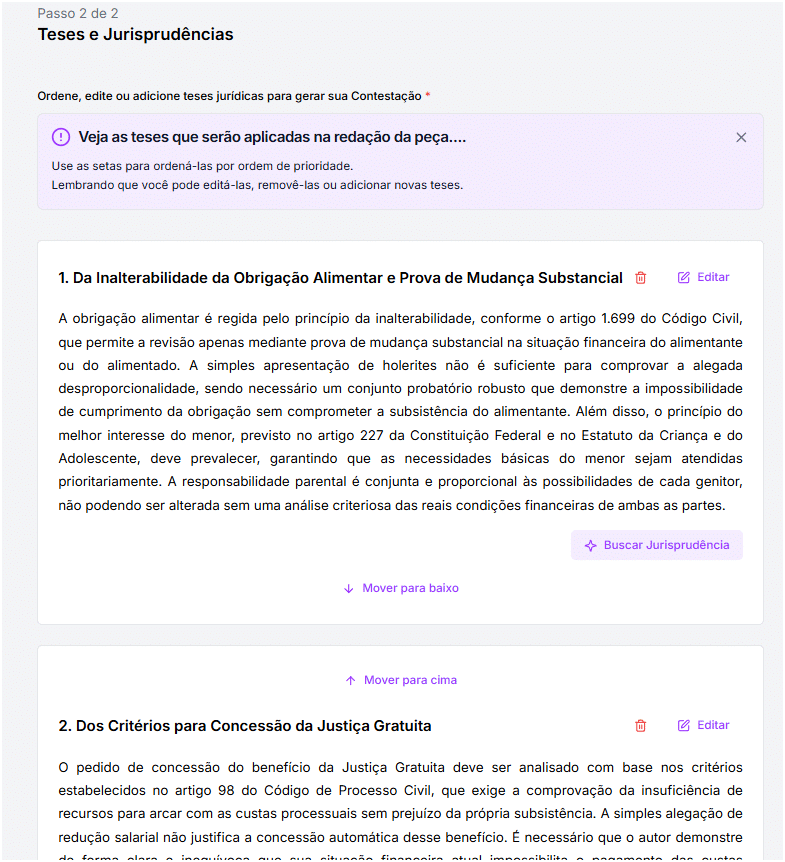
Click the “Generate Document” button.

Step 6: The contestation of the pension reduction carried out by artificial intelligence in the revisional action is completed and prepared for submission.
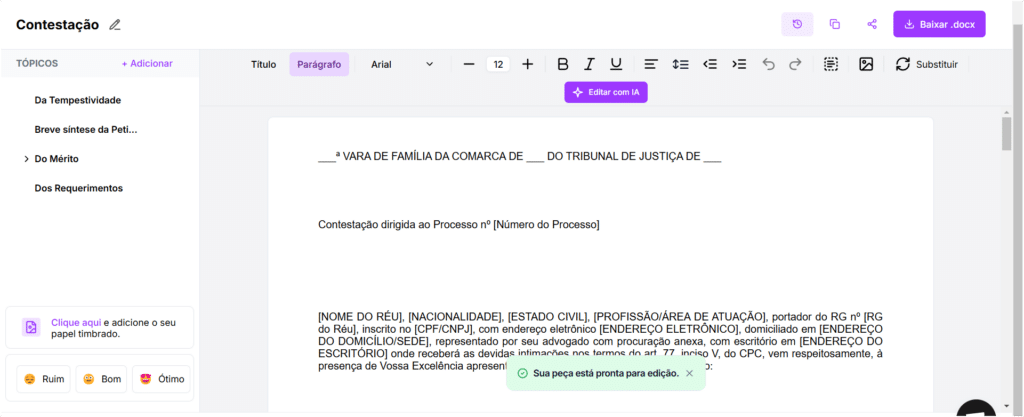
For Legal AI technology to handle law more accurately and comprehensively, it is crucial to offer thorough details about the case, particularly the facts leading up to the verdict.
By inputting the information accurately and clearly, you will guarantee that your AI-generated task is tailored and legally more precise and efficient!
Don’t forget to look at our tutorial in the question center!
What benefits come from using our AI for attorneys?
- Quickness and Efficiency: reduces the time needed to draft procedural sections by generating well-structured minutes rapidly.
- Our AI adapts the writing based on the specific requirements of the case to provide a well-supported argument.
- The platform is updated with recent legal decisions and important legislative changes to ensure your compliance with current laws.
- By automating the creation of legal documents, you can concentrate on case strategy and customer service, known as Strategic Time Leveraging.
