

In Brazilian procedural law, divergence embargoes play a distinct role in maintaining the consistency of decisions made by higher courts.
This is a technical tool designed to address conflicting interpretations and maintain the consistency of prior decisions.
This article presents a straightforward and unbiased exploration of the key aspects related to this legal recourse.
We will cover the key points to grasp its purpose and when it can be used, as well as effective strategies to enhance success, without neglecting its unique qualities.
We will also focus on real-life scenarios like the impact of the changes in the composition of the group and the careful technical attention needed to prevent rejection due to formal flaws.
By the conclusion of this reading, you will gain a comprehensive and strategic understanding of how divergence embargoes are utilized to achieve judicial uniformity, a crucial task for ensuring predictability and security within the Brazilian justice system.
Legal background of Divergence Embargoes
The embargoes of divergence, as outlined in Article 1.043 of the Code of Civil Procedure, aim to resolve interpretative inconsistencies within the same higher court prior to a final decision.
Its main goal is to guarantee legal certainty and predictability in court rulings, which are crucial values for the rule of law in a democratic society.
Divergence embargoes can be filed based on differences in the application of substantive or procedural law according to Article 1043, § 2 of the Civil Procedure Code.
Identifying the divergence accurately is crucial for the proper use of this tool, and it must be verified with great technical precision by comparing the judgment under review with the standard.
Both decisions must show that they address the same legal matter but propose different resolutions.
In-depth legal research is advised, including a survey of higher court databases, to find the most suitable landmark cases.
The decisions within the court’s jurisprudence must reflect current issues and diverse viewpoints.
It is crucial to clearly articulate the legal thesis, presenting it precisely and objectively while emphasizing the points of agreement and disagreement in the interpretation of the issues at hand.
Divergence Embarges’ Function
The name of the appeal itself suggests its intention: divergence embargoes aim to settle internal jurisdictional conflicts within the same higher court.
It is a mechanism designed to standardize the legal interpretation among the different entities that comprise these courts.
The main concept of the appeal is to avoid having conflicting legal arguments coexisting in the same court simultaneously, which could undermine legal certainty and the predictability of rulings.
In both the Supreme Court (STF) and the Superior Court of Justice (STJ), it is crucial for the institutions to uphold consistent interpretations, with the STF having two classes and the STJ being divided into six classes organized in three sections.
Understand what Embargoes mean in relation to Execution.
When are funships suitable?
Embargo divergences are carefully limited in order to maintain judicial coherence within higher courts.
It is not widely accepted but serves as a tool to resolve disagreements within the court.
Divergence embargoes are suitable when two collegial decisions of the same court have adopted conflicting legal solutions for the same legal issue.
Legal disputes must have significant relevance to justify standardization, rather than being a tool for resolving individual or isolated differences.
Concrete damage caused by the host of the event is another crucial aspect to consider regarding the cabling.
Divergent monocratic decisions do not face embargoes, even if they are significant in terms of decision-making content.
The appeal is not necessary if the disputed decision aligns with previous rulings or established precedents, whether from the same court or the Supreme Court.

Divergence Embarges Deadline
The deadline for filing divergence embargoes is 15 business days from the receipt of the disputed decision.
This principle aligns with the usual criteria set for many assets in the Brazilian legal system, as outlined in the Civil Procedure Code.
The deadline for filing appeals and responding to them is 15 days, excluding appeals against decisions on embargoes.
The countdown starts upon the official notification of the decision by legal representatives or authorities as stated in the article.
The deadline is based on working days rather than calendar days in the current procedural system.
Procedural methods for standardizing jurisprudence through Divergence Embarges
When divergence embargoes are the final feasible procedural option, certain particular tactics can greatly enhance the likelihood of success.
- Renowned jurist specializing in the subject of divergence presents a legal opinion, lending doctrinal support to the advocated thesis.
- Illustrating how jurisprudence affects the country’s legal system, emphasizing the uncertainty caused by inconsistency.
- Utilization of statistical information and contemporary research findings to demonstrate the societal and economic importance of the matter.
- Focusing on demonstrating technical divergence and proposing judicial pacification is part of strategic oral support.
- Memorial preparation that is brief and technically perfect, which was previously given to judges.
It is feasible to organize a performance that is more technical and focused based on these instructions.
Mapping divergence involves identifying conflicting judgments within the court and clearly establishing opposing legal arguments.
Success in creating resources is closely connected to thorough technical analysis and the establishment of a strong and clear legal basis.
During the trial, the lawyer’s performance should be strategic, concentrating on clear oral arguments that specifically address the key areas of disagreement.
Precise and technical communication is crucial for convincing judges and showing the necessity of standardization.
It is essential to also take into account the impact of judicial consequences, which enhance effectiveness and support the establishment of legal principles by encouraging monitoring and sharing of previous decisions.
The success of using divergence embargoes to achieve judicial uniformity hinges on both meeting formal admissibility criteria and the lawyer’s ability to emphasize the court’s internal inconsistency and the necessity for interpretive reconciliation.
Divergence embargoes, if effectively handled, can serve as a key factor in maintaining cohesion within the legal system by enhancing the predictability and stability of higher court rulings.
Explore: Statement Boards at CPC – Eligibility and Time Limit [Handy Guide]
Change in the makeup of the Judicial Body
After the decision, the significant shift in the makeup of the judicial body poses an extra hurdle in managing dissenting opinions.
This more common situation in higher courts necessitates specific strategic tactics to enhance the chances of success on appeal.
It is important to conduct a thorough assessment of the legal status of the new judicial members initially.
Thorough research on voting patterns in similar cases, doctrinal articles, and public discussions on divergence can help achieve this.
This existing knowledge will adjust the legal argument to align with the beliefs that the judges have already stated.
Another suggested approach is to underscore the institutional aspect of the divergence embargoes, emphasizing that the goal is to standardize the court’s jurisprudence as an entity, irrespective of its current makeup.
Arguing that jurisprudence goes beyond changes in membership can be convincing in this situation.
In severe situations of significant changes in the composition, it might be advisable to seek a public hearing or allow amicus curiae involvement, particularly if the differing issue has considerable social or economic impact.
These actions broaden the legal discussion and enhance the credibility of the ultimate ruling, reducing the impact of the change in composition.
It is recommended to provide a historical overview of the development of legal principles related to the issue, placing the differences in the court’s decision-making context.
The new judges can better grasp the broader institutional context of the issue, which helps them make decisions that align with the court’s legal practices.
Care is essential when preparing the Divergence Embargoes memorial.
Formal vices often reject divergence embargoes, which is a common occurrence in legal practice. To prevent this issue, it is crucial to take technical precautions when preparing the memorial.
- It is crucial to carefully conduct an analytical comparison by directly including the differing opinions and clearly explaining the legal arguments they oppose in a clear and instructive manner. The comparison must be explicit and logical, effectively proving the presence of judicial divergence.
- It is important to establish the tactical similarity between the cases being compared in order to show that they are substantially alike, thus eliminating any significant tactical differences that could invalidate the consideration of the appeals.
- Formal requirements for admissibility must be thoroughly checked to ensure all procedural conditions are met, including preparation, legitimacy, ongoing interest, and alignment with the legal criteria outlined in Article 1.043 of the Civil Procedure Code.
- The selection of the judgment paradigm must be done carefully, using current and relevant precedents from the court’s established jurisprudence while avoiding outdated decisions in favor of more recent interpretations.
The memorial should be organized logically and cohesively, starting with an introduction that outlines the controversy, followed by a detailed explanation of the differences, and ending with a summary of the main argument.
The language should be technical yet easy to understand, without being overly wordy or using unnecessary arguments.
See the tips we have selected for you:
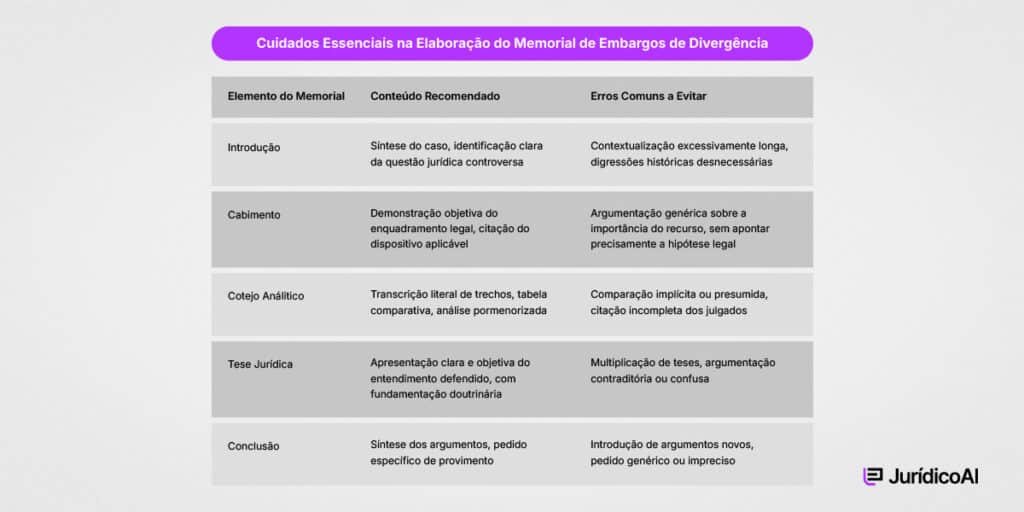
The table helps to identify the key components required for the memorial of divergence embargoes, emphasizing the suggested content and common mistakes to be prevented.
This tool is valuable for assessing the document’s organization and improving the process performance with greater accuracy and efficiency.
What do Divergence Embargoes refer to?
Divergence embargoes are a tool outlined in Article 1.043 of the Civil Procedure Code, used to address conflicting interpretations in decisions from various divisions of the same higher court.
Its goal is to guarantee legal predictability and consistency in legal decisions, avoiding contradictory stances in the same court.
What is the purpose of the Divergence Embarges?
The primary purpose is to standardize the internal legal decisions of higher courts like the STF and the STJ.
The appeal aims to avoid having contradictory legal opinions in various courts at the same time, which could undermine the consistency and reliability of court rulings.
When do pleasure boats fit?
Conflicting collegial decisions on the same legal issue with similar circumstances can be considered when supported by technical rigor, as specified in Article 1.043 of the Civil Procedure Code.
The difference must also be legally significant, and challenges to individual decisions are not allowed if they follow established rules or precedents.
What is the name for the interposition of the Divergence Embarges?
The time limit is 15 business days starting from the service of the challenged decision, as specified in Article 1.003, § 5 of the Civil Procedure Code. The calculation should be based on business days, following the same method as other applicable deadlines.
What sets Declaration Embargoes apart from Divergence Embargoes?
The Declaration of Embargos seeks to address any omissions, contradictions, or uncertainties present in the original decision.
The Divergence Embargoes aim to address conflicts between decisions made by different bodies within the same court. One group corrects its own decision, while the other works to standardize differing interpretations.
What are the criteria for admission for the Divergence Embargoes?
The following requirements must be adhered to.
Tempestivity refers to a 15-day period; Preparation is necessary at times; Legitimacy and appeal interest; Clearly show differences with specific analysis; Keep cases simple; Select relevant and recent precedent.
How can the difference be shown?
The difference must be shown with a thorough analysis comparing conflicting judgments and explaining the opposing legal arguments in a specific and well-supported manner to demonstrate a real conflict among the judges.
Can embargoes be imposed on decisions made by a single person?
The divergence embargoes apply only to collective decisions. Appeals against individual decisions are not allowed, even if they are significant. Appeals are also not accepted when the decision follows a binding precedent.
What methods enhance the likelihood of success in Divergence Embarges?
Important strategies for convincing judges to revise their thesis include obtaining a legal opinion from a well-known jurist, showing the practical consequences of divergence, utilizing statistical data and empirical studies, providing strategic oral support, and presenting a clear, technical, and concise memorial to the judges beforehand. These tactics aim to emphasize the significance of standardization and persuade the judges of the necessity for revising the thesis.
What precautions should be followed when preparing the memorandum of differences embargoes?
The memorial should have a concise introduction presenting the legal dispute, an analytical discussion of the different court decisions, a demonstration of fairness, adherence to all formal requirements, selection of a relevant judgment as a reference point, and an objective approach using clear and accessible language to prevent rejection due to unnecessary complexity.
