
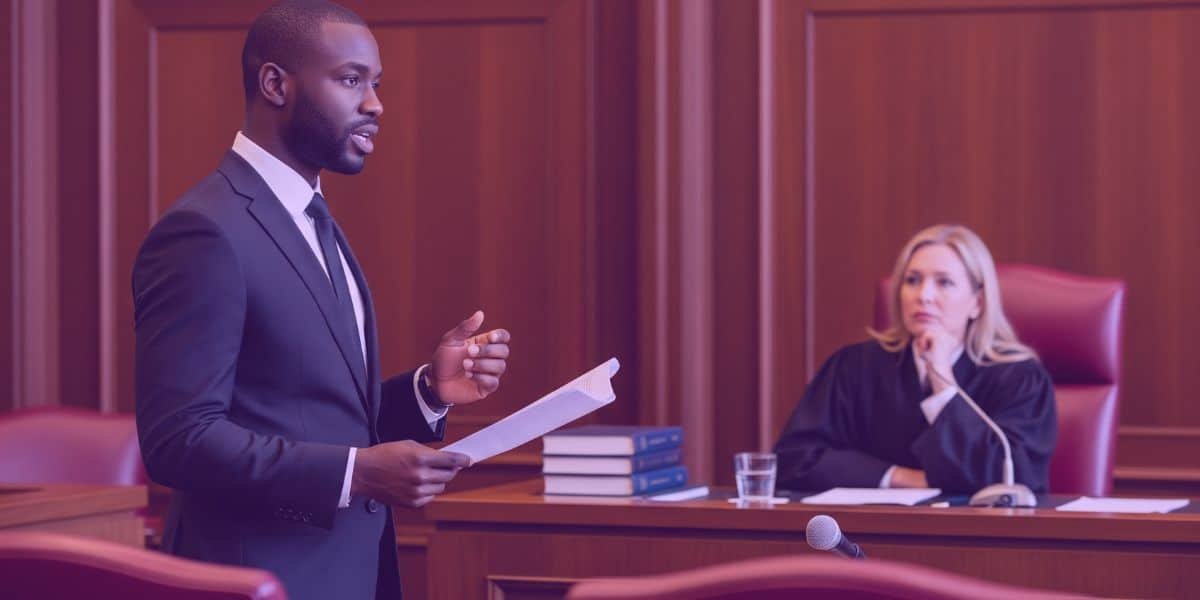
Oral advocacy in the legal field is a crucial opportunity for lawyers to showcase their skills in presenting clear and persuasive arguments, which can determine the outcome of a case.
This article will outline the primary methods for providing effective verbal assistance, including useful suggestions and a guide that incorporates the utilization of legal technology.

What is meant by oral support?
Oral support in a trial involves presenting and emphasizing key arguments made by the lawyers to help the judges make their decision.
This process enhances what was written and enables active engagement with colleagues.
It is a special chance to address contentious issues, showcase past examples, and underscore the justification of the argument, aiding in the development of a more significant judgment.
It is a tool that merges persuasive language and legal skills to enhance the protection of consumer rights in a more empathetic and convincing manner.
When does verbal assistance take place?
Oral assistance takes place during a trial session, following the presentation of the case by the rapporteur and before the conclusion of the trial by the panel.
The president of the session now allocates time, typically 15 minutes, to each party including the Public Prosecutor to present their arguments.
This moment is important as it enables the lawyer to engage with the judges, emphasizing key points and modifying the argument based on the new details that emerge during the session.
When is it suitable to provide oral assistance?
The use of oral assistance can differ based on the type of proceeding and the specific characteristics of each appeal, requiring careful consideration.
Next, we examine the most important hypotheses, organized according to the procedural system in place.
CPC oral assistance
Oral assistance is available in various forms as stated in Article 937 of the CPC/15, allowing each party to present their arguments during the trial session following the rapporteur’s initial presentation.
It can support arguments in certain situations.
- Appeal;
- Common asset.
- Special request;
- Extraordinary request.
- Misunderstanding panels.
- Rescission procedure, protective order, grievance.
- The legal tool specifies an unlikely 15-minute timeframe, enabling lawyers to concentrate on the key points.
Furthermore, Section IX of the article allows internal court rules to enhance or expand the possibilities of communication.

Oral argument in Instrument of Appeal
Oral support was made feasible in instrument agraves interposed against interlocutory decisions on provisional safeguards of urgency or evidence with the CPC/15 innovations.
The hypothesis permits lawyers to advocate for a thorough examination and potentially challenge a single judge’s decision that affects the procedural advancement, even in cases not focused on the merits.
Oral assistance for CPP
Oral testimony is crucial in legal proceedings, particularly in criminal appeals, under the Criminal Procedure Code (CPP).
The specific ritual is intended to support the overall strategy of presenting arguments orally, which enables lawyers to enhance written arguments with details that could be crucial in reassessing the facts and determining the sentence.
Oral presentation in Habeas Corpus
While habeas corpus is typically a top priority, there are situations where verbal approval is permissible, particularly in collegial decisions regarding urgent matters of freedom.
It is crucial for the lawyer to be familiar with the court’s internal rules to determine if oral arguments for a habeas corpus petition are allowed.
Support provided verbally during TRT
Oral assistance in regular appeals and grave petitions is primarily provided within the scope of Labor Justice (TRT).
Each Regional Labor Court has its own procedures that lawyers must understand in order to present arguments clearly and effectively.
Advancements in Legal Legislation
Law 14,365/2022, which revised the Statute of the Law (Law 8,906/1994), expanded the rights to legal assistance through verbal communication.
Lawyers are allowed to use the phrase “by order” in court to intervene and clarify any misunderstandings or doubts that could impact the decision, as stated in the revised Article 7.
Can oral assistance be provided through video calls?
The law allows for the option of receiving oral assistance through video calls.
According to Section 4 of Article 937 of the Civil Procedure Code:
The attorney may provide oral support through videoconferencing or other real-time technology if they have a professional domicile in a different city from where the court is located, as long as they make the request by the day before the session.
This type of service seeks to increase access to justice and guarantee that physical distance does not hinder the complete exercise of legal representation.
Suggestions to enhance proper oral support
To make your spoken assistance more impactful and unforgettable, think about implementing these advanced tactics.
- Thorough examination of the procedure.
Perform a detailed analysis of the documents, evidence, and arguments presented to uncover hidden details that can be further explored in support.
- Creating a thorough script.
Organize your presentation in a rational and cohesive manner.
Divide your speech into sections: a short introduction, presenting the key points, organizing the legal arguments (preferably with three strong supporting pillars), and concluding with a compelling summary and any requests.
Legal artificial intelligence can assist with drafting and structuring the document. Simply log into our platform and explain the content you wish to present to the judge.
Our legal artificial intelligence will develop a personalized model with sound logic to support you in your legal matter.
- Intense training and hands-on assessments.
Practice oral support simulations, and consider recording your presentation to assess intonation, rhythm, and clarity.
Ask for input from coworkers or mentors and be ready to adapt your speech as needed.
Consistent practice is necessary to decrease anxiety and ensure a smooth and secure presentation.
- Technical and emotional aspect:
It is essential to show empathy and ensure safety when communicating, in addition to having technical knowledge.
Maintain a polite stance and steer clear of using overly complicated language that may hinder understanding.
Provide specific examples that demonstrate how your arguments can be applied in real court cases, ensuring that your evidence is not only technical but also relatable and convincing.
- Adapting to the surroundings and utilizing technology resources.
When engaging in video conferencing, ensure that the setting is well-prepared with appropriate lighting, a reliable internet connection, and a professional environment.
Be ready to utilize screen sharing tools when presenting supporting documents or graphics.
- Be cautious of the choice of words and timing.
Be concise and avoid reading a decorated script word for word.
Adjust your speech based on the reactions of the audience to maintain focus on the most pertinent arguments.
Respecting the deadline is not just a procedural necessity; it also shows professionalism and consideration for others in the group.
The Art of Persuasion in the Public Platform
Oral support is the last chance for the attorney to turn written arguments into a convincing and decisive spoken presentation.
By becoming proficient in procedural regulations, employing carefully devised tactics, and utilizing technological assistance like Legal AI during preparation, the lawyer can project confidence and potentially sway the magistrates’ decisions.
Investing in high-quality oral support is crucial for defending customer rights in a fast-paced and challenging environment.

Article 937 of the CPC, what does it state?
During the trial session, Article 937 of the CPC states that the President will allow the applicant, defendant, and, if necessary, the Public Prosecutor to speak for up to 15 minutes each to present their arguments following the rapporteur’s explanation of the case.
Who is the first to provide verbal support?
Usually, the applicant speaks first, followed by the rapporteur’s presentation, with the President then inviting the applicant to present their arguments.
How can I view live assistance?
Oral assistance can be supervised in court or, if possible, via video conferencing broadcasts. Numerous courts make these interactions available on their authorized channels, enabling the public and legal experts to participate.
When is it appropriate to file an appeal?
Oral assistance is suitable in appeals filed against preliminary rulings concerning temporary guardianships, allowing the attorney to challenge the single judge’s decision and strengthen key arguments in the case.
What are the dangers of exceeding the allotted time for oral assistance?
Exceeding the allotted time can lead to the presentation being abruptly stopped, hindering the communication of arguments and impacting judges’ evaluations, while also showing a lack of organization and disregard for the rules.
What is the significance of verbal assistance during the resource evaluation process?
Oral assistance enables the lawyer to elucidate and reinforce the key aspects of the appeal, providing a chance to engage with the judges and impact the decision promptly and directly.
How to get ready for a successful oral presentation?
The preparation involves conducting a thorough analysis of the cases, creating a precise and unbiased script, conducting practical tests (preferably recorded for review), and utilizing tools like Legal AI to identify previous cases and structure arguments strategically.
What are the primary time management considerations for oral care?
Respecting the court’s time limit is crucial, so it’s important to avoid being overly long and reading the script word for word. Prioritizing key points in arguments and rehearsing can help keep the presentation within the allotted time.
How did technology influence verbal assistance?
The advancement of technology has made it easier for lawyers to present their cases through video calls, allowing professionals from various places to participate and utilize visual aids like screen sharing to strengthen their arguments.
What are the typical errors that occur during verbal assistance?
Common mistakes often seen in presentations are being too wordy, reading directly from a script, not staying focused on the main points, showing excessive nervousness, and not tailoring the language to the audience. Steering clear of these errors can greatly enhance the impact of your presentation.
